LinkedIn offers unique targeting: job title, seniority, industry, and company size. When those signals can truly sharpen a program, MPP considers LinkedIn. Budget, LTV, and other criteria are taken into account when evaluating whether to recommend LinkedIn to a program. For the right program, LinkedIn can be highly effective. For the wrong program, it can be a budget black hole.

Where LinkedIn fits inside Orbit.

LinkedIn shines when the buying process involves more than one decision-maker and involves a longer consideration window than B2C campaigns require. Orbit ties LinkedIn's account and title-level targeting to what paid search is capturing for intent and what retargeting is doing lower in the funnel. The job of LinkedIn is to cover parts of the buying committee that can't be reached by those channels. Orbit is what connects it all together.

At the core of Orbit sits the Hi-5, five questions asked at the start of a program and throughout it.


Orbit logo

How Hi-5 works in LinkedIn.

Campaign resonance icon
Resonance
Does the messaging speak to the actual role and seniority level being targeted, or is it generic B2B copy that could run on any platform?
media cohesion icon
Cohesion
Does the creative read as credible inside a professional feed, or does it look like a consumer ad that wandered onto the wrong platform?
Media reach icon
Reach
Is targeting built around job title, industry, and company size, or account lists through Matched Audiences, matched to how the actual buying committee is structured?
media allocation icon
Allocation
Is LinkedIn's budget going toward the titles, industries, and accounts most likely to influence a real buying decision, or is it spread across a broad audience because the client is B2B?
Reporting icon
Reporting
Are we measuring qualified leads and pipeline influence, the outcomes LinkedIn is actually suited to drive, rather than judging it against cost-per-click benchmarks set by cheaper platforms?

How Core vs. Explore works in LinkedIn.

Core

Core holds the job titles, industries, and ad formats already proven to generate qualified engagement. Most of the budget stays concentrated here, where the targeting precision LinkedIn is built for is already working.

Explore

A smaller slice of budget tests something unproven, a new title or seniority segment, a new ad format, a first attempt at an account list built from Matched Audiences. Segments that prove out can move into Core or continue running on additional budget requested to support them. Segments that don't perform get cut quickly.

What MPP builds and manages.

01

Professional Audience Targeting

Campaigns built around job title, seniority, industry, and company size, the targeting data unique to LinkedIn, rather than the broader interest-based targeting other platforms rely on.
02

Account-Based Targeting

Target account lists uploaded through Matched Audiences for programs where specific companies, not just job titles, define the audience. MPP applies its ABM Lite approach selectively, on programs where account-level precision earns its cost, not as a default add-on to every LinkedIn program.
03

Format Strategy

Sponsored Content, Message Ads, and document ads selected based on the buying stage and seniority being targeted, not run uniformly across every campaign.
04

Platform-Native Measurement

Optimization and reporting are built around what LinkedIn's platform natively reports and the use of LinkedIn's Insights Tag, with campaign strategy following that data rather than a custom measurement layer added on top.
05

Deliberate Budget Planning

Recommendations get built around available budget and pipeline value during planning, rather than assumed as a fixed line item for every B2B client.

What shows up in HelloMPP

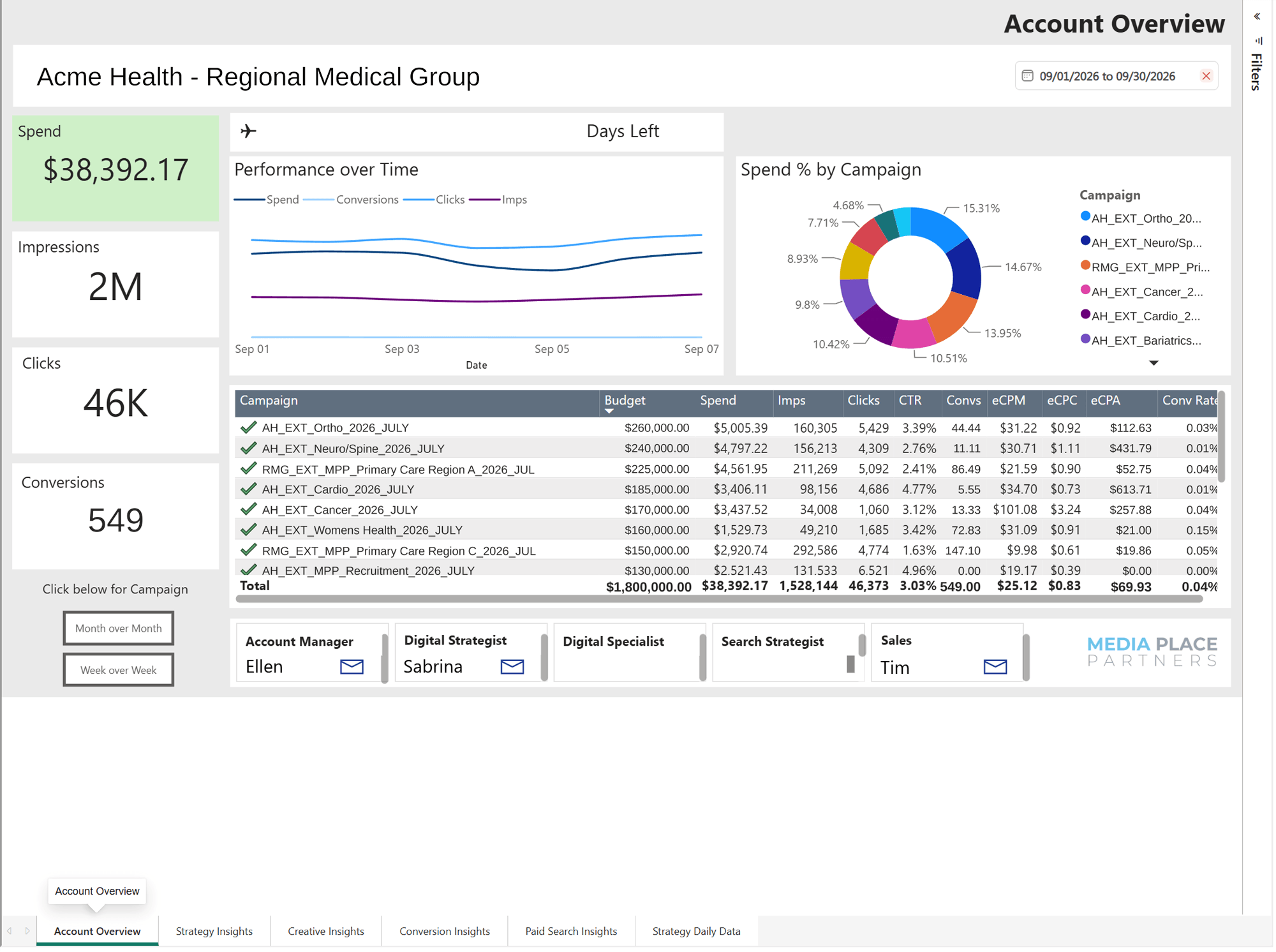
LinkedIn performance feeds into HelloMPP, MPP's proprietary client analytics portal, updated twice daily. Campaigns and ad lines get named around the segments they target, so lead volume and cost per lead stay visible by audience, even though title and industry data itself isn't a native reporting field.
Explore HelloMPP →
HelloMPP account overview screenshot

Is LinkedIn right for your plan?

LinkedIn is a strong fit when:

  • The buying process involves multiple decision-makers across different roles or seniority levels
  • Job title, industry, or company size are meaningful qualifiers for the audience
  • Account-based targeting against a defined list of target companies would meaningfully improve the program
  • The audience and budget make LinkedIn's targeting precision worth its premium cost

LinkedIn is a weaker fit when:

  • The audience is broad or consumer-facing rather than defined by professional role or company attributes
  • The program doesn't have a defined buying committee or clear decision-maker profile to target
  • Budget doesn't support LinkedIn's cost per click at a sustainable volume

Frequently asked questions about LinkedIn advertising

Is LinkedIn advertising worth the higher cost per click?
It depends on budget and audience precision. LinkedIn's targeting data, job title, seniority, industry, company size, isn't available anywhere else, and for programs where that precision shortens the sales cycle or reaches decision-makers other channels can't, the premium is worth paying. For lower-value transactions or broad consumer audiences, that same cost usually isn't justified, and MPP says so during planning rather than defaulting to LinkedIn because the client is B2B.
Does MPP run account-based marketing (ABM) on LinkedIn?
Yes, selectively. MPP applies a lightweight ABM approach on LinkedIn for programs where a defined list of target accounts genuinely improves precision, but it's a labor-intensive approach and isn't applied by default to every LinkedIn program. It gets recommended where the accounts and effort involved actually justify it.
What targeting options does LinkedIn offer that other platforms don't?
Job title, seniority, industry, company size, and skills, professional and firmographic data that consumer platforms like Facebook and Instagram don't have access to. That's the core reason LinkedIn earns a place in B2B programs despite its cost.
How does MPP measure LinkedIn advertising performance?
Measurement centers on lead quality and pipeline influence rather than raw click volume, using LinkedIn's own platform-reported data. Campaigns and lines get named around the segments being targeted, so performance stays visible by audience even without a native title or industry breakdown in reporting.
Does LinkedIn advertising work well alongside other channels?
Yes, particularly paid search. LinkedIn often builds awareness with a specific buying committee while paid search captures the demand that awareness creates. MPP plans LinkedIn as one part of the funnel, not an isolated B2B checkbox.

Is LinkedIn reaching the right people?

If LinkedIn is running in your plan but you aren't sure who it's targeting or questioning the cost, it's time to talk to MPP.

Handwritten text that says we're easy to talk to, pinky swear.
LinkedIn logo icon

Say hello to MPP.

MPP delivers transparent media planning and buying with a system you can understand and results you can measure. Orbit, the Hi-5, and Core vs. Explore keep decisions accountable. HelloMPP dashboards keep performance visible. If you're ready for a partner that makes every dollar defendable, that's exactly what we do.

Let's get to work.
Media Place Partners the Midwest Marketing Agency Logo
3351 Claystone Street, SE
Suite 102
Grand Rapids, MI 49546
616-285-5429