MPP builds and manages paid search programs across Google Ads, Microsoft Advertising, and Local Service Ads, structured to capture demand where it surfaces, control waste, and produce results that hold up under pressure.
Reach people already looking for what you offer.

Paid search advertising is a form of digital advertising where ads appear on search engine results pages in response to specific user queries. Advertisers bid on keywords and pay when users click, making paid search a demand-capture channel that reaches people at the moment they are actively looking for a product or service.
In the U.S., paid search runs primarily on Google Ads and Microsoft Advertising (Bing). For service-category businesses, Local Service Ads operate as a distinct ad format within the paid search ecosystem, appearing above standard results with a verification-based trust signal and a pay-per-lead pricing model rather than pay-per-click.
MPP plans allocation based on where your audience searches and what the economics of your category support.

Google processes more than 5 trillion searches annually and holds roughly 84% of U.S. search engine market share. For most clients, Google Ads is where the performance foundation is built and where the majority of paid search budget is concentrated.

Microsoft Advertising (Bing) captures approximately 10% of U.S. search volume. Depending on category competition and cost-per-click dynamics, Bing can be a meaningful efficiency lever. MPP evaluates the economics during planning rather than defaulting to a Google-only allocation.
LSAs are a Google-verified ad format for service-category businesses that appear above standard search results. Advertisers pay per qualified lead rather than per click, and the Google Guaranteed or Google Screened badge signals trust directly in the results. MPP manages LSAs as part of the paid search program for clients where local and service-based intent drives qualified demand.
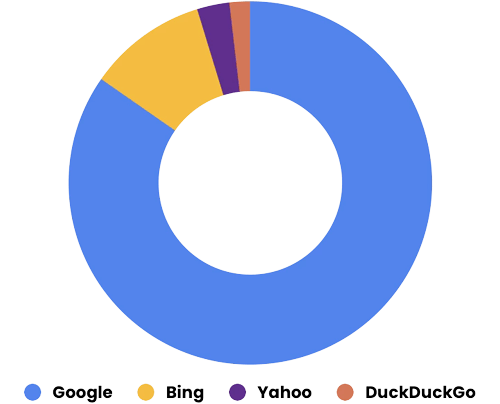
U.S. search engine market share, February 2026. Google 84.13%, Bing 10.52%, Yahoo 2.86%, DuckDuckGo 1.84%. Source: StatCounter.
MPP delivers paid search through Orbit, MPP's marketing operating system. The work is organized around Hi-5, a five-question diagnostic framework applied across every engagement, and governed by Core vs. Explore, which controls how budget moves between the proven program and controlled testing.
Explore Orbit →




Core vs. Explore is how MPP balances stability with improvement.
Core is the performance foundation of the program. The campaigns, keyword themes, match types, and ad combinations that have proven they produce qualified conversions consistently. Core is protected, funded, and managed to perform. Experimentation does not happen here.
Explore runs alongside Core as a controlled testing environment. New intent themes, messaging angles, landing page approaches, and keyword expansion opportunities are evaluated here without putting the core program at risk. Explore carries its own budget so Core is never compromised by a test.
When something in Explore outperforms Core, it graduates. That is how paid search programs improve over time rather than plateau.
Explore Core vs. Explore →
Paid search performance feeds into HelloMPP, MPP's proprietary client analytics portal, updated twice daily. Spend, conversions, efficiency, and week-over-week changes are consolidated in one place without waiting on a scheduled report.
The designation is reserved for agencies that meet Google's thresholds for campaign performance, managed spend volume, and staff certification, and it is maintained through ongoing performance rather than awarded once. For clients running Google Ads, that credential is a meaningful signal about the agency managing their investment.