Hi-5 is MPP's proprietary planning and optimization methodology. Five diagnostic questions govern every decision inside an Orbit program: who we're reaching, what we're saying, where we're running, how we're adjusting, and whether we're measuring what matters. They're asked at the start of every program. They're asked throughout. When the answers change, the program changes with them.
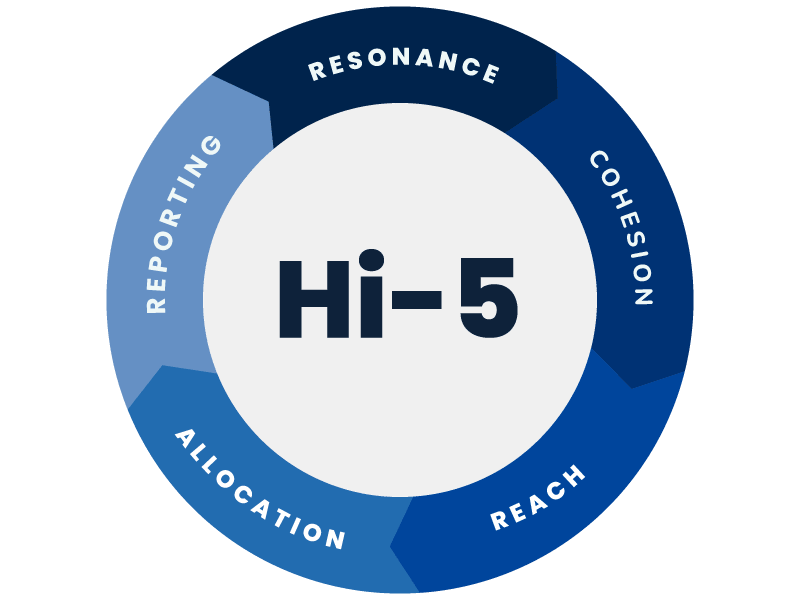
Most media programs have a plan. Fewer have a consistent framework for interrogating that plan while it's running. The plan defines what goes live. What's less common is a shared set of questions that governs what happens next: when to hold budget in place, when to shift it, when to change the message, when to add a channel, and when to stop something that isn't working.
The plan defines what goes live. Hi-5 determines what happens next.
Without that structure, optimization becomes reactive. Decisions get made in isolation, channel by channel, vendor by vendor, with no common logic connecting them. A paid search team optimizes toward its own metrics. A social team does the same. Neither set of decisions is wrong on its own terms. But the program isn't making decisions; its parts are.
Hi-5 gives the full program a shared decision-making language. The same five questions apply at the channel level and across the program simultaneously, which is what keeps individual channel decisions connected to overall strategy rather than drifting apart over time.
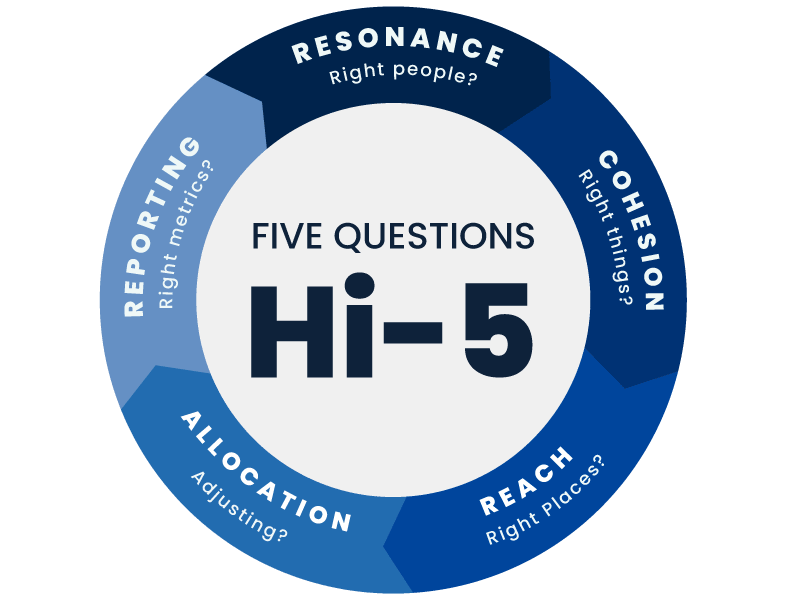
Resonance is the audience question. It asks whether the program is actually reaching the people it's designed to reach, with enough specificity that the message has a reason to land. Audience definition that was accurate at launch can drift as the program runs. Signals shift. Platforms change how they serve ads. First-party data ages. Resonance keeps the audience question live rather than treating it as settled once the campaign is built.
Cohesion is the message question. It asks whether what the program is saying is consistent with the brand, appropriate for the channel, and matched to where the audience is in their decision process. Consistency doesn't mean identical execution across every platform. It means the same story told in ways that fit each context. This is also where Core vs. Explore operates, the framework that governs how much of the program runs proven messaging versus tested alternatives.
Reach is the channel and placement question. It asks whether the program is present where the target audience actually is, at the right frequency, in the right formats. High impression volume in the wrong environments is a reach problem, not a success metric. Reach also asks about format fit and about frequency: whether the audience is seeing the message enough to matter without being served it so often it stops working.
Allocation is the budget question. It asks whether the program is moving spend toward what's performing and away from what isn't, in real time rather than at the end of a flight. Budget inertia is one of the most common performance problems in media. Hi-5 treats allocation as a continuous decision rather than a fixed commitment, which means the plan running at the end of a quarter reflects what the data has been saying rather than what the original plan assumed.
Reporting is the measurement question. It asks whether the program is measuring outcomes that connect to business goals rather than metrics that are easy to collect but disconnected from what the program is trying to do. Reporting defines which numbers drive decisions before campaigns launch, then holds the program accountable to those numbers throughout.
The difference between a planning checklist and a diagnostic methodology is what happens after launch. A checklist gets completed. A methodology stays active.
Hi-5 is applied three times in every program cycle. Before launch, it shapes the plan: defining the audience, setting the message, selecting channels, establishing how budget will move, and determining what gets measured. During the program, it runs as a continuous diagnostic, flagging when audience signals are shifting, when message performance is declining, when a channel is earning its budget and when it isn't. After each cycle, it feeds the findings back into the next plan.
The program running in month six is different from the one that launched. What hasn't changed is the five questions driving all of it.
Hi-5 is the methodology at the core of Orbit, MPP's marketing operating system. Every activation and optimization decision inside an Orbit program runs through the five questions. The Intelligence Layer translates Hi-5 findings into strategy and creative direction. The Activation Layer executes against them.
Reporting is the fifth Hi-5 question, and HelloMPP is where the answers live. Performance data from every active channel feeds into MPP's proprietary client analytics portal, updated twice daily, consolidating delivery, pacing, spend, and outcomes across the full program.

The Hi-5 Framework is what keeps a media program accountable to its own goals after launch. Every channel, every optimization decision, every budget shift runs through the same five questions. That's what makes the program at the end of the year stronger than the one that started it.