Broadcast still captures 28.2% of household TV viewing nationally, reaching an audience no other channel replicates at the same scale. MPP negotiates broadcast and cable inventory directly with local and national providers, buying specific stations, programs, and dayparts matched to the audience a plan calls for.

How MPP runs broadcast TV

Every channel MPP manages runs inside Orbit, specifically on the Hi-5, five questions asked at the start of a program and throughout it. Here's how the Hi-5 looks in broadcast TV.

Explore Orbit →


Campaign resonance icon
Resonance
Are we buying programming and dayparts where the audience actually lines up with who this business needs to reach? A broadcast schedule can hit a huge number of households and still miss the audience a program is built for.
media cohesion icon
Cohesion
Is the creative built for the format it's running in? A :30 spot built for broadcast needs to work within the medium's pacing and production standards, not get repurposed from a digital asset that wasn't made for it.
Media reach icon
Reach
Are we buying the right mix of stations, networks, and dayparts, including cable inventory where it extends reach efficiently? Broadcast's strength is scale, and Hi-5 keeps that scale pointed at the audience the plan calls for instead of the biggest available signal.
media allocation icon
Allocation
Is broadcast earning the share of budget it's getting based on what it's actually producing for the program, not on habit or a rep relationship? Spend moves based on performance data, the same as every other channel.
Reporting icon
Reporting
Are we tracking what broadcast is actually built to do, mass reach and brand impact, rather than holding it to conversion metrics it was never designed to produce?
Explore Hi-5 →

How Core vs. Explore works in broadcast TV

Core vs. Explore is how MPP balances stability with improvement.

Core

Core is the stations, dayparts, and programs that have proven they deliver the reach and audience fit a plan calls for. Core is protected and funded to perform. Testing doesn't happen here.

Explore

Explore runs alongside Core with its own defined budget: a station MPP hasn't run before, a different daypart, a program outside the usual rotation. When something in Explore earns its place, it moves into Core. When it doesn't, it stops without disrupting what's already working.

Explore Core vs. Explore →

What MPP builds and manages

Station and Network Negotiation
Rates, availability, and inventory secured directly with local and national providers, evaluated against audience fit rather than accepted at rate card.
Daypart and Program Selection
Placements chosen against the audience a plan calls for, whether that's early morning news, primetime, sports, or syndicated programming.
Cable Inventory Integration
Cable buys planned alongside broadcast in the same schedule, extending reach where it strengthens the plan rather than treated as a separate purchase.
Creative Specs and Trafficking
Spots delivered to each station's technical requirements and trafficked to run on schedule, with production guidance provided where a client needs it.
Ongoing OPtimization
Schedules adjusted as ratings data comes in. A program or daypart that stops performing gets reworked, not left to run out the buy.
Ongoing optimization
Active management across queries, bids, budgets, and creative throughout the program. Performance improves continuously, not only at launch.

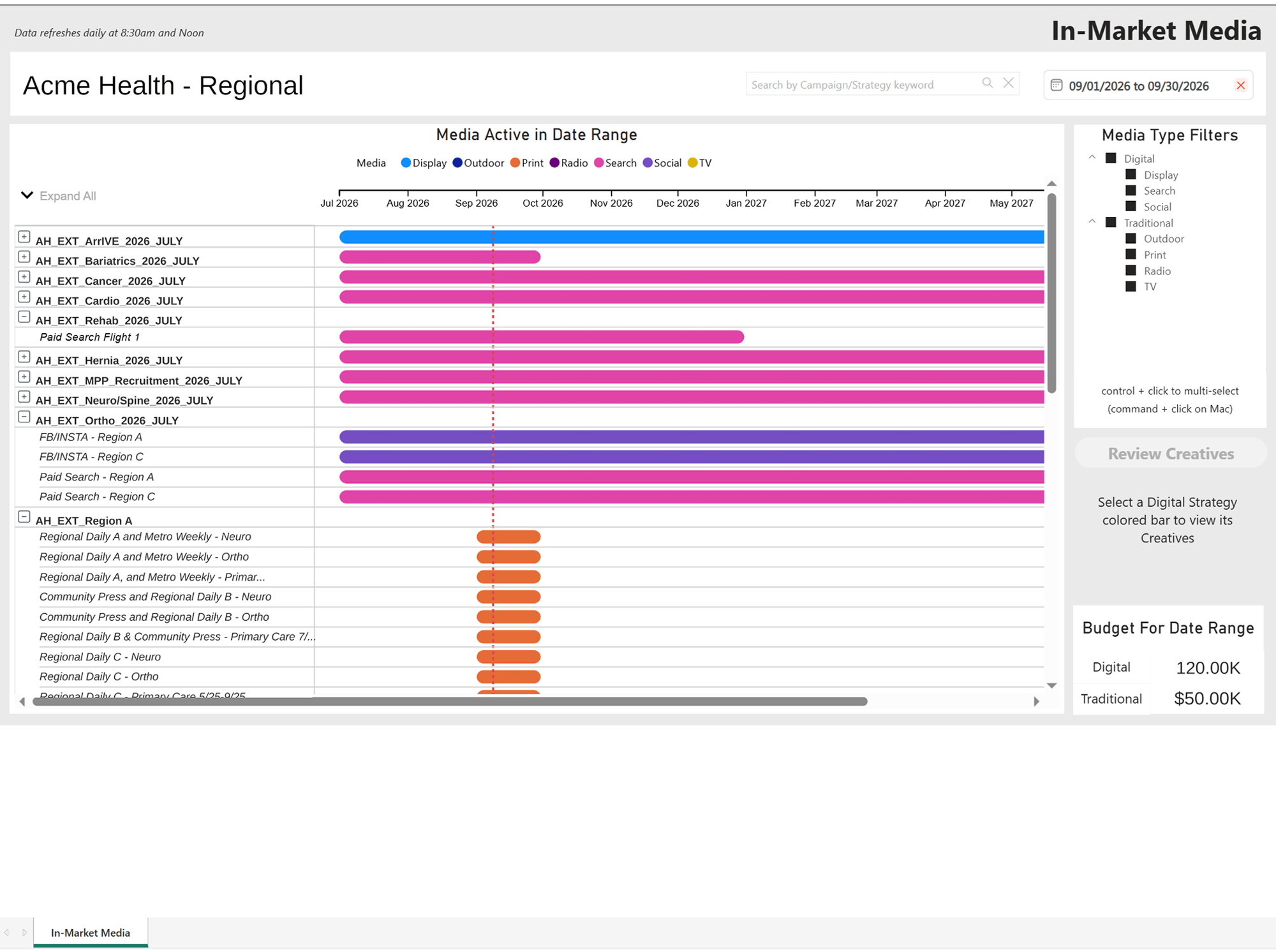
What shows up in HelloMPP

Broadcast TV doesn't generate the same kind of data digital advertising does. There's no click, no impressions, no dashboard reporting back results in real time. Broadcast placements MPP manages show up in HelloMPP on the in-market report: what's running, on which stations, and when. In-market provides visibility into the schedule alongside every other channel in the program.

Explore HelloMPP →

20+ years of direct relationships

National TV buying often runs through a national rep firm, adding layers of cost and distance between the buy and the market. MPP negotiates broadcast and cable placements directly with local station and network reps whenever the market supports it, backed by relationships built over more than two decades. Because MPP is media-neutral, those relationships aren't about commission structures. MPP recommendations reflect rate and audience fit, not which rep pays the agency the most to run their inventory.
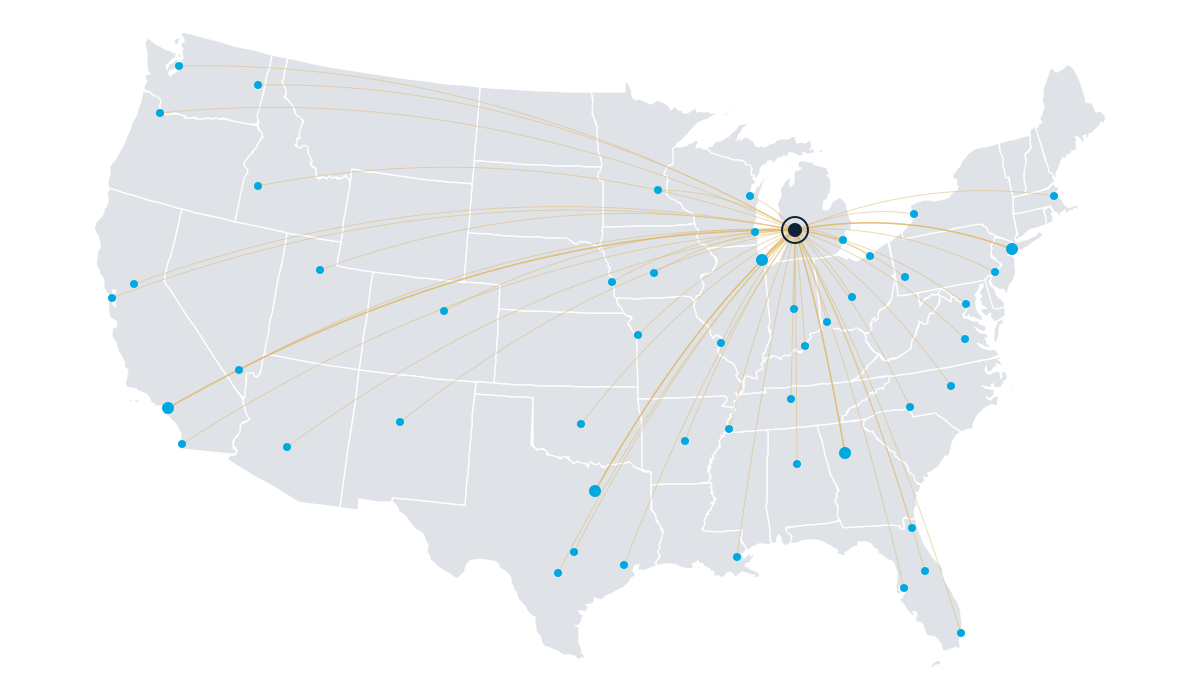
US map showing MPP buying locally

Is broadcast TV right for your plan?

TV is a strong fit when:

  • A message needs to reach an entire market at once, not a narrow segment
  • Brand awareness and credibility carry real weight in the buying decision
  • The category benefits from being seen in a trusted, brand-safe environment
  • Budget can support meaningful frequency, not a single spot running occasionally

TV is a weaker fit when:

  • The goal is a specific, trackable conversion with no awareness component
  • The audience is narrow enough that mass reach wastes most of the buy
  • There's no budget to run with enough frequency to register
  • Creative isn't ready to meet broadcast's production and technical standards

Frequently asked questions about TV advertising

What's the difference between broadcast TV and cable TV advertising?
Broadcast TV airs over public airwaves on networks like CBS, ABC, NBC, and Fox, and reaches viewers at no cost regardless of how they access it. Cable TV airs on networks distributed through pay-TV providers, typically offering more targeted programming categories. MPP buys both as part of the same TV advertising plan, choosing the mix that fits the audience and reach goals of the program.
How are TV commercial ratings measured, and does DVR or streaming viewing count?
TV ratings are measured by Nielsen through a panel of monitored households that tracks who watched a program and when. Modern ratings increasingly account for time-shifted viewing, including DVR playback within a set window, commonly three or seven days, and viewing through connected TV apps tied to a subscription. MPP builds media plans against the ratings methodology relevant to each buy, since how a spot gets counted affects what it's actually worth.
Is TV advertising still worth it for small businesses?
Yes, but the approach depends on the business and market. Broadcast still captures a significant share of household TV viewing nationally, and local news and programming give advertisers access to regional audiences without requiring a national budget. MPP builds TV schedules sized to what a program can actually support, rather than requiring a minimum spend to make the channel viable.
What's the difference between a national and a local TV advertising buy?
A national buy runs across a network's full footprint, reaching viewers nationwide regardless of market, and is typically negotiated well in advance through upfront or scatter markets. A local buy targets a specific station or market, useful for businesses that only need to reach a defined geographic area. MPP evaluates both options against where a program's actual audience lives, rather than defaulting to one or the other.
How much lead time or production is needed for a TV commercial?
Lead time depends on the complexity of the spot. A produced commercial with original footage typically needs several weeks for creative development, filming, and editing, while a simpler spot built from existing assets can move faster. Local and regional stations often have shorter creative turnaround requirements than national network placements. MPP scopes production timelines during planning so a launch date isn't at risk of the creative not being ready.

Is TV running without being tied to the rest of your plan?

If broadcast or cable is currently bought and left on its own, disconnected from what's happening in digital, it's time to have a conversation with MPP.

Handwritten text that says we're easy to talk to, pinky swear.
Television advertising icon

Say hello to MPP.

MPP delivers transparent media planning and buying with a system you can understand and results you can measure. Orbit, the Hi-5, and Core vs. Explore keep decisions accountable. HelloMPP dashboards keep performance visible. If you're ready for a partner that makes every dollar defendable, that's exactly what we do.

Let's get to work.
Media Place Partners the Midwest Marketing Agency Logo
3351 Claystone Street, SE
Suite 102
Grand Rapids, MI 49546
616-285-5429