The audience has moved. MPP plans and buys streaming TV + video across CTV, OTT, and YouTube, reaching people wherever they are watching, with audience targeting that broadcast cannot replicate.
Streaming TV + video advertising is the placement of video ads inside content delivered over the internet to connected devices, including smart TVs, streaming sticks, tablets, laptops, and mobile phones. It encompasses three distinct environments: connected TV (CTV), which delivers streaming content on a television screen; over-the-top (OTT), which refers to the delivery method that bypasses traditional cable and satellite distribution; and online video platforms such as YouTube, which deliver video content on demand across every device type.
Unlike linear television, streaming TV + video advertising uses audience data to reach defined segments by behavior, interest, content consumption, and geography, rather than purchasing time slots and hoping the right viewers are watching. Ads run inside premium content at full screen and, depending on the platform and format, are non-skippable or carry completion rates that linear TV cannot measure.
At MPP, streaming TV + video is managed as a demand-driving channel inside Orbit, coordinated with paid search, programmatic, and paid social rather than planned in isolation as a standalone video buy.
Linear TV and cable were, for decades, the most reliable path to a mass video audience. That path still exists, but a significant portion of the audience has migrated to connected devices, streaming platforms, and on-demand video. They are not unreachable. They just require a different buying approach.
The migration is generational in one direction but not exclusive to any age group. Adults under 45 are disproportionately light linear viewers or have never held a cable subscription. Adults 45 and older are increasingly adding streaming alongside cable rather than replacing it. The result is a fragmented audience spread across environments that require separate buying infrastructure to reach.
Viewing moments matter as much as viewing hours.
Connected TV and online video are consumed differently than scheduled broadcast. Audiences on CTV are leaning back, watching full-screen content in the living room, in a high-attention environment where ads run at completion rates that rival or exceed linear TV. Audiences on YouTube are often in a different posture: searching for content by intent, which means the context of what they are watching is a signal about what they need. Both are opportunities. They are not the same opportunity, and planning them as if they were produces a weaker buy.
A streaming video buy that is not connected to the rest of the program is a reach channel without context. MPP coordinates streaming TV + video with paid search and paid social so that the audiences being reached through video have a coherent path through the rest of the program.
When video builds awareness and search captures the resulting demand, both channels produce more than they would separately.
Each environment has different inventory characteristics, audience behaviors, ad formats, and measurement realities. CTV delivers to the living room screen with high completion rates and premium inventory. OTT includes CTV but also encompasses streaming on non-TV devices, which changes the context of ad exposure.
YouTube operates differently from both: it is a search-driven platform with intent signals baked into content consumption, and it requires a separate bidding, targeting, and creative strategy. Collapsing all three into a single line item misrepresents how the channel actually works. MPP manages them with the distinctions the buying environment demands.
Streaming TV + video targeting goes well beyond content genre and daypart. MPP builds audience segments from behavioral data, content consumption patterns, geography, and first-party signals where available. Those segments determine where impressions run, not the other way around.
Reaching the same audience across CTV, OTT, and YouTube without accounting for cross-platform exposure is one of the more common ways streaming budgets get wasted. Each platform manages frequency inside its own walls.
MPP plans for total exposure during the buying process, setting per-platform frequency parameters with the full program in view rather than optimizing each environment in isolation and discovering the overlap after the fact.
Streaming TV + video drives awareness and consideration. At the upper end of the funnel, the outcomes are not always immediate conversions, and measuring it as if it were a direct response channel misrepresents its contribution.
MPP establishes measurement frameworks during planning that account for where streaming fits in the overall program, including brand lift signals, search volume lift, and downstream conversion attribution where it can be tracked.
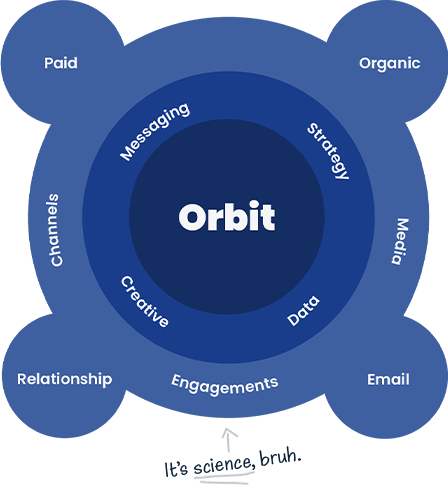
Streaming TV + video raises awareness and keeps a brand present with audiences in high-attention environments. Search captures what streaming builds. Social reinforces it in a different context. Programmatic display extends it to the open web. Those connections do not happen automatically. They are planned inside Orbit, where the Hi-5 runs across every channel simultaneously: Are we reaching the right people? Is the message landing? Are we in the right places? Are we adjusting as signals come in? Are we tracking what actually matters?
Budget moves through Core vs. Explore. The proven audiences and formats that produce results are the Core. New environments, formats, and targeting approaches run in Explore on a defined budget. When something in Explore outperforms, it moves into Core. When it does not, it stops.
Streaming TV + video performance feeds into HelloMPP, MPP's proprietary client analytics portal, updated twice daily. Delivery, pacing, completion rates, and spend are consolidated in one place without waiting on a scheduled report.
Explore HelloMPP →