digital Advertising

Streaming audio reaches people during activities where there are no screens, like commuting, exercising, working, and running errands. MPP plans and buys streaming audio as a precision channel within a media plan, using contextual and behavioral targeting to put your message in front of the right listener at the right moment.

How MPP runs streaming audio

Platform-direct buying, coordinated inside the program.

01

Platform-direct relationships, not DSP pass-through.

MPP buys streaming audio directly with each platform rather than through a demand-side platform. That means the targeting, placement decisions, and creative specs are negotiated and managed with Spotify, Pandora, SiriusXM, and iHeart directly. It also means the reporting comes from the source, not filtered through an intermediary layer. For clients, the practical result is cleaner inventory access, more direct campaign control, and a clearer line between what was bought and what ran.
02

Contextual targeting built around how people listen.

Streaming audio audiences self-select into context. Someone listening to a workout playlist is in a different mindset than someone deep in a true crime podcast. MPP uses that context as a primary targeting input, aligning placements to music genre, station type, and listening environment where the platform supports it. Demographic and geographic targeting layers on top. The goal is not just reaching the right person, it's reaching them in a moment where the message fits what they are doing.
03

Coordinated with the rest of the digital program.

Streaming audio rarely runs as a standalone channel inside an MPP program. It is typically planned alongside paid search, programmatic display, or paid social, with each channel assigned a specific role. Audio handles reach in screen-free moments. Search captures intent when that same audience is ready to act. Display reinforces the message in between. The channels do not have to be running simultaneously to be coordinated, they have to be planned with each other in mind.
04

Creative efficiency when terrestrial radio is already in the mix.

For clients running terrestrial radio alongside digital, existing radio assets can often be adapted for streaming audio placements, reducing production burden and keeping the message consistent across listening environments. MPP evaluates creative fit during planning. When a radio asset works for streaming, we use it. When it does not, we say so and identify what the platform requires instead.

Where MPP buys streaming audio

MPP places streaming audio directly with four platforms, selected for their reach, targeting capabilities, and audience composition.

Spotify

Anchor for adults under 45

With more than 100 million monthly listeners in the U.S., Spotify offers audio placements across music, playlists, and podcasts on ad-supported accounts. Targeting includes age, gender, geography, playlist context, and listening behavior. Companion display units are available on screen-based devices. Spotify is typically the anchor platform in a streaming audio program for clients targeting adults under 45.

P

Pandora

Adults 25 - 54 genome targeting

Pandora operates under the SiriusXM portfolio, though it is bought and planned as its own distinct environment with its own targeting mechanics. Pandora's ad-supported tier reaches tens of millions of U.S. listeners monthly with strong penetration among adults 25 to 54. Its music genome targeting allows placements alongside specific stations and genres with a level of contextual precision that aligns well with mood- and activity-based messaging strategies. Pandora also reaches listeners on smart speakers at a higher rate than most platforms.

SiriusXM

National reach • in-vehicle audience

SiriusXM combines satellite radio with a streaming component that reaches audiences across vehicles, connected devices, and the web, and includes Pandora within its broader portfolio. The platform provides access to a broad national audience, including listeners who are less reachable through Spotify or Pandora alone. For clients in categories like automotive, finance, or sports, SiriusXM's channel lineup and listener demographics can make it the right fit for specific program goals.

iHeart

broad digital radio + podcast

iHeart's digital radio network covers broadcast stream simulcasts, curated stations, and podcast inventory across a wide range of formats and markets. Its audience is broader than its broadcast radio legacy suggests. iHeart's digital listeners span adults 18 to 54, with strong representation among younger demographics who use the platform for curated stations and podcast content. For clients already running terrestrial radio with MPP, iHeart is a natural extension into digital listening environments. For clients who have avoided it based on an assumed older skew, the actual audience composition is worth a closer look before writing it off.

Podcast advertising placement.

Podcast advertising is a distinct format within streaming audio and one MPP plans for clients where the audience, format, and content alignment support it. Podcast ads run as host-read or produced spots inserted at the pre-roll, mid-roll, or post-roll position inside individual episodes. They reach audiences who are highly attentive and self-selected into a specific topic or format, which produces strong message retention relative to most digital formats.

MPP evaluates podcast advertising based on show relevance, audience composition, and whether the format suits the message. A produced audio spot written for Spotify may not be the right creative execution for a host-read podcast placement. Planning the two together requires treating them as related but distinct placements, with separate creative considerations for each.
When streaming audio belongs in the program.

Streaming audio is a strong fit when:

  • The program needs to reach people during activities where screens are not present, like commuting, exercising, working, running errands
  • The audience skews toward adults under 55 who are active digital audio consumers
  • Terrestrial radio is already in the mix and extending the message into streaming environments makes strategic sense
  • The program benefits from frequency and message reinforcement outside of visual channels
  • Creative can be produced or adapted to meet audio-first format requirements

Streaming audio is weaker when:

  • The objective is direct-response and the program has no surrounding channels doing audience building or consideration work
  • The target audience is not an active streaming listener on any of the four platforms MPP buys on
  • The creative budget cannot support audio production or adaptation of existing assets
  • The program is too narrow in scope or budget to support a meaningful streaming buy alongside other channels
ORBIT + HI-5

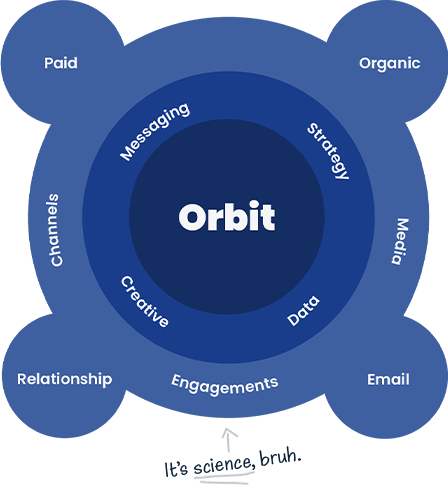
Streaming audio inside the Orbit system.

Streaming audio does not optimize itself in isolation inside an MPP program. The Hi-5 framework applies at the channel level and across the full program simultaneously. For streaming audio, that means asking whether the listener context matches the message (Resonance and Cohesion), whether the platforms and placements are earning their budget relative to other channels (Reach and Allocation), and whether performance is being measured against outcomes that matter rather than raw impressions (Reporting).

In practice, that last question is where streaming audio programs most often need discipline. Impression volume on audio platforms is easy to generate. What it produces downstream, like search activity, site visits, and conversion lift requires measurement planning before the program runs, not after results are already in.

Core vs. Explore applies to streaming audio the same way it applies to every channel. The proven platform, targeting approach, and creative format hold the core allocation. A defined portion tests new contexts, formats, or platform placements. When a test produces a measurable improvement, it moves into the core. When it does not, it stops.

Internet Advertising Bureau Member Logo

MPP is an IAB member

The Interactive Advertising Bureau publishes the standards that govern clean programmatic supply, including ads.txt, sellers.json, OpenRTB, and the verification frameworks buyers rely on. IAB membership means MPP buys inside those standards rather than working around them.


Streaming audio FAQ

What is the difference between streaming audio advertising and traditional radio advertising?
Traditional radio advertising reaches audiences through broadcast signals with estimated reach figures based on market surveys. Streaming audio advertising reaches individual listeners on digital platforms with targeting based on actual listener data including demographics, geography, genre preference, and device. Streaming audio also delivers verified impression counts rather than estimated reach. The two channels serve different moments. Terrestrial radio has broader mass reach, while streaming audio offers precision targeting and measurability that broadcast cannot match.
Which platforms does MPP buy streaming audio on?
MPP buys streaming audio directly with Spotify, Pandora, SiriusXM, and iHeart. Platform selection depends on the client's audience, geography, campaign objectives, and budget. Most programs involve two or more platforms to cover the range of listening environments where the target audience is active.
How does MPP target streaming audio listeners?
MPP uses a combination of contextual targeting based on music genre, station type, and listening environment, layered with demographic and geographic targeting available through each platform. Contextual targeting, matching the ad to what someone is listening to and why, is the primary lens MPP applies when the platform supports it. Behavioral and first-party audience data layer in where it strengthens the match.
Can existing radio creative be used for streaming audio?
Often yes, depending on the asset and the platform. Terrestrial radio spots can frequently be adapted for streaming audio placements, which lowers production costs and keeps the message consistent across listening environments. MPP evaluates creative fit during planning. When an existing asset works, the program benefits from the efficiency. When it does not, MPP identifies what the platform requires and scopes creative accordingly.
How is streaming audio performance measured?
Streaming audio performance is measured against the goals defined during planning, which typically include reach, frequency, audio completion rate, and downstream outcomes such as site visits or search lift. Raw impression volume is not a sufficient measurement on its own. MPP defines what gets measured before the program runs and surfaces the results.
Is streaming audio a standalone channel or does it work better as part of a larger program?
Streaming audio works best as part of a coordinated digital program where each channel has a defined role. Audio handles moments when visual channels cannot reach the audience. Search captures intent when that audience is ready to act. Display reinforces the message across other touchpoints. Running streaming audio in isolation is possible but limits the program's ability to convert the awareness audio builds into downstream outcomes. MPP plans streaming audio with the rest of the program in view from the start.

Running a digital program that should include audio?

If streaming audio belongs in your mix and you are not sure how to plan it against the rest of what you are running, that is a conversation worth having with MPP.

Handwritten text that says we're easy to talk to, pinky swear.
Streaming audio advertising icon

Say hello to MPP.

MPP delivers transparent media planning and buying with a system you can understand and results you can measure. Orbit, the Hi-5, and Core vs. Explore keep decisions accountable. HelloMPP dashboards keep performance visible. If you're ready for a partner that makes every dollar defendable, that's exactly what we do.

Let's get to work.
Media Place Partners the Midwest Marketing Agency Logo
3351 Claystone Street, SE
Suite 102
Grand Rapids, MI 49546
616-285-5429
